
- This event has passed.
Newport Wetlands & Goldcliff Lagoons
September 6 @ 07:30 - 16:00
Leader: Simon Ashley
Time: 7.30am start – meeting at Cheapside Car Park, Stroud, returning around 4.00 pm. Sites: RSPB Newport Wetlands (Uskmouth) in the morning, Goldcliff Lagoons in the afternoon.
About the day
Early September is one of the best weeks of the year on the Gwent Levels. Autumn wader passage is at its height, summer migrants are still trickling south, and the first of the winter wildfowl are beginning to arrive — so this is a day where almost anything is possible. We are making a full day of it and covering two contrasting parts of the Newport Wetlands National Nature Reserve, timed around the tide.
Morning: RSPB Newport Wetlands
The RSPB reserve occupies 438 hectares of reclaimed industrial land between the Severn Estuary and the River Usk — reedbeds, lagoons, wet grassland, saltmarsh and scrub, with the estuary mudflats beyond. It is one of the best reedbeds in Wales, and the site holds 7,500-year-old human footprints and auroch bones in its layers of silt.
We will work the reedbed and lagoon trails while the birds are active in the cool of the morning, then walk out to the sea wall to scan the estuary over low water.
Afternoon: Goldcliff Lagoons
A few miles east along the coast, Goldcliff is a different proposition entirely — three shallow, muddy scrapes (Monk’s, Prior’s and Bec’s Lagoons) behind the sea wall, watched from three hides and four viewing platforms. It is the premier wader site in the county.
Low water at Newport on 6 September is at 8.27am and high water at 3.04pm. That gives us the estuary and its exposed mud during the morning at Uskmouth, and then a rising tide through the afternoon at Goldcliff — exactly when waders get pushed off the estuary and onto the lagoons in front of the hides. The last couple of hours should be the best of the day.
What we might see
At RSPB, the reedbed specialities are the draw: Bearded Tit, Cetti’s Warbler, Water Rail and Reed Bunting are all far more frequent here than the regional average, and Bittern, Marsh Harrier, Great White Egret, Little Egret and Kingfisher are all on the September list. Little Owl is resident. Late Reed and Sedge Warblers, Blackcap, Whitethroat, Lesser Whitethroat, Chiffchaff and Willow Warbler will be moving through the scrub, with Whinchat, Stonechat and Northern Wheatear on the fence lines and Swallows, House Martins and Sand Martins gathering overhead. From the sea wall: Shelduck, Curlew, Whimbrel, Black-tailed and Bar-tailed Godwit, Dunlin, Ringed Plover, Redshank and Greenshank, plus the first returning Wigeon and Teal, and a good chance of Peregrine.
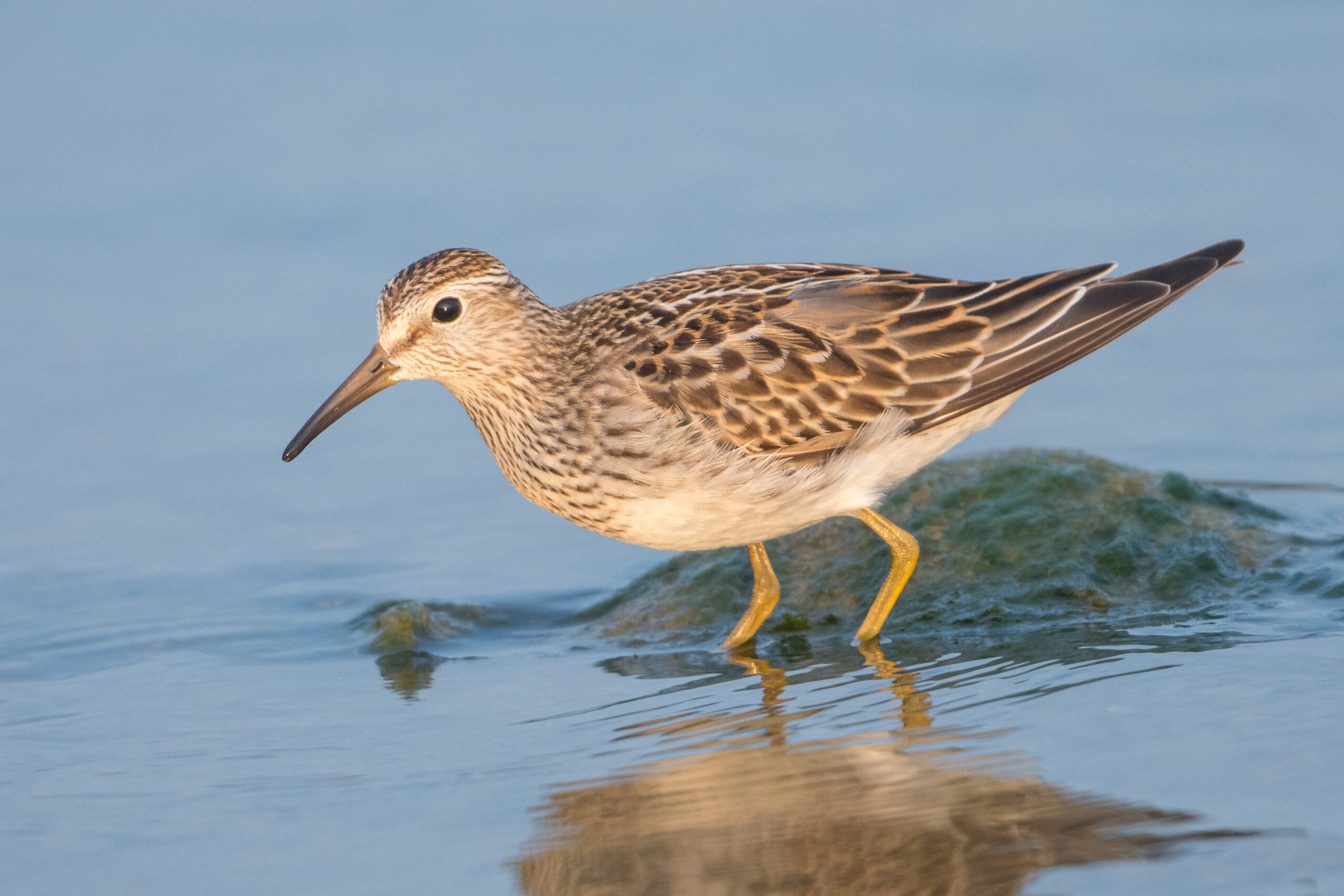
At Goldcliff, the lagoons in early September can hold a remarkable wader list: Avocet, Black-tailed Godwit, Ruff, Spotted Redshank, Greenshank, Little Stint, Curlew Sandpiper, Green, Wood and Common Sandpipers, Dunlin, Snipe, Lapwing, Ringed and Little Ringed Plover, Golden and Grey Plover, Knot, Sanderling and Turnstone. Garganey are a real possibility among the ducks, and Yellow Wagtail, Wheatear and Whinchat work the sea wall and the fields behind.
The extra cool thing about Goldcliff is the rarities that turn up. September records at Goldcliff include Pectoral Sandpiper, Semipalmated Sandpiper, Buff-breasted Sandpiper, Lesser Yellowlegs, Grey and Red-necked Phalarope, Glossy Ibis, Eurasian Spoonbill and Wryneck. No promises — but this is the site, and this is the month.
Practical information
- A telescope is well worth bringing — much of the viewing at Goldcliff is at range.
- Boots or wellingtons. The track around the Goldcliff lagoons can be muddy even in a dry spell.
- Bring a packed lunch and plenty of water. There are no facilities at all at Goldcliff — no toilets, no shelter, no refreshments.
- Parking at the RSPB reserve is £5 for non-members and free for RSPB members and Blue Badge holders. Entry to the reserve itself is free.
- RSPB facilities: the car park is open 9.00am–5.00pm, the visitor centre and toilets 9.30am–5.00pm, and the café 10.00am–4.00pm. The reserve itself and its hides are open 24 hours.
- At Goldcliff, parking is on the roadside east of Goldcliff village; from there, you cross the road and follow the path over a small bridge to the reserve entrance. Please park considerately — it is a narrow lane through a residential area. (We’ll go in convoy from the morning site)
- The trails at the RSPB reserve are level, compacted gravel, and there is disabled access to each of the Goldcliff hides.
- Car sharing is encouraged — it is roughly an hour’s drive from Dursley, and parking at Goldcliff is limited, so we’ll coordinate on WhatsApp as usual.
If the trip has to change
If the trip is in doubt because of bad weather or unexpected circumstances, or has to be cancelled, we will try to contact everyone by phone and through the WhatsApp group.
Further reading
- eBird: Newport Wetlands NNR — Uskmouth Lagoons and RSPB Reserve — 167 species recorded
- eBird: Newport Wetlands NNR — Goldcliff Lagoons — 184 species recorded
- RSPB Newport Wetlands
- Friends of Goldcliff Lagoons
_(29119997223).jpg)